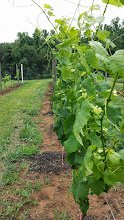
This is the third Cabernet Springs Farm has made from
local grapes. The first Cab Sav we
crushed on the day my wife and I got married in 2010. We now refer to it as the “Wedding
Wine’. We always seem to be making wine
on or around our anniversary now, which is not a bad thing at all. I skipped making wine in 2011 & 2013 due to other
farm projects. In 2012 we made 5
gallons of some beautiful stuff. I can’t
wait to do a vertical tasting of all three.

2014 was a great year for grapes in Virginia. It was a mild summer with cool nights and not a lot of rain. The only thing I noticed in my own vineyard is the Japanese beetles were fierce in numbers. I feel pretty lucky to get grapes this year as grapes are in big demand these days in VA.


:
10.11.14
|
Procured 6 (very full) lugs from local vineyard.
Set up the “crush pad” and prepared for the crush and destem. Sanitized all equipment and then a quick
BRIX check of 23 from refractometer.
After the crush the addition of SO2 is added to kill off any wild
yeasts or bacteria. Let it sit for 24
hours.
|
10.12.14
|
 Tested must for specific gravity and acid: Tested must for specific gravity and acid:
SG 1.087
Expected Alcohol about 12%
Barrel Temp 66*
T.A. resulted in the addition of an acid blend
Added Pectin Enzyme
Expected yield < 10 gallons
Created yeast starter and pitched Pasteur yeast
|
10.13.14
|
 Strong fermentation, punched down twice a day Strong fermentation, punched down twice a day |
10.17.14
|
SG 1.010 temp 66*
|
10.20.14
|
SG 1.000 Added malolactic bacteria
|
10.25.14
|
   |
10.28.14
|
 |
11.23.14
|
Racked, tart taste, added French oak chips to 9 gallons
|
12.25.14
|
Sampled how the oak is coming along, needs a bit more
time to mellow. Good bouquet
|
1.4.14
|
Racked off oak, it is tasting like it might be a big
wine, it has a great bouquet, it’s just starting to round out a little but
it is still quite sharp and tight.
|


